
Retention vs Reactivation vs Acquisition: Different Mechanics — Different Channels
8 min read
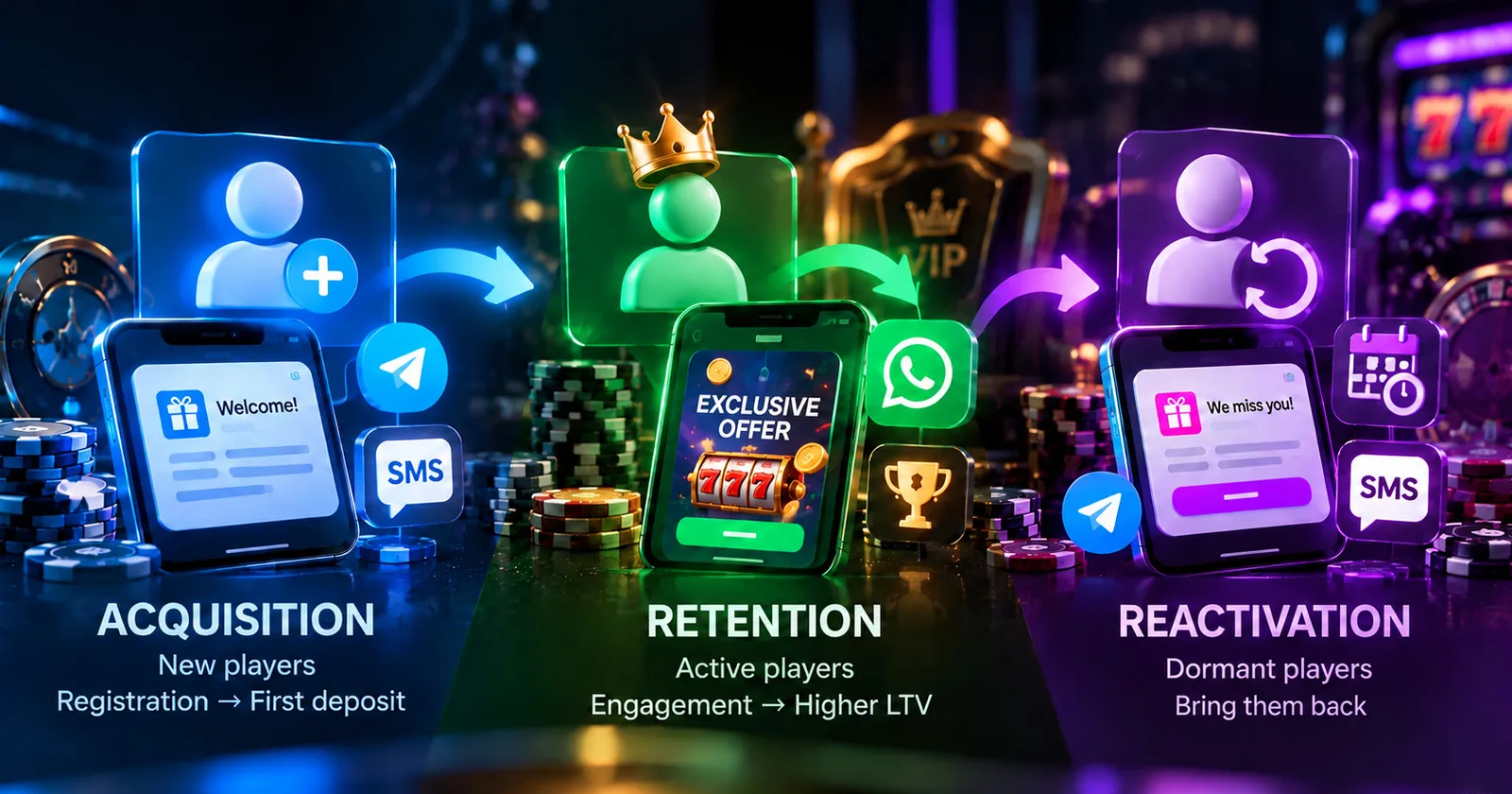
In iGaming, retention, reactivation, and acquisition are not just marketing buzzwords — they represent three fundamentally distinct stages of user communication.
When an operator builds audience communication, they often mix these three tasks into a single message stream. In practice, acquisition, retention, and reactivation in iGaming are independent directions, each with its own logic, channels, and metrics. Blending them results in lower response rates, higher unsubscribe rates, and wasted budget. Let's break down how they differ and why sending a single message to your entire database is a gamble rather than a strategy.
1. Three Tasks Frequently Confused in CRM Communications
Acquisition in CRM communications covers the initial interaction stages with a new user right after registration. The objective is to guide them through the welcome flow, identity verification, and other platform steps up to their first target action (FD).
Retention focuses on active users who regularly engage with the platform. Key factors here include database segmentation, personalization, touchpoint frequency, and LTV (Lifetime Value). The goal is to sustain interest and extend player lifecycle without overwhelming them with messages.
Reactivation triggers when a user stops showing activity. Communication shifts from holding their attention to bringing them back. The CRM team sets the inactivity threshold based on product analytics — for example, a specific number of days without logins, deposits, or other key actions.
Thus, the line between retention and reactivation is not defined by a universal timeline, but by each platform's segmentation rules. As long as a user fits the active segment criteria, retention scenarios apply. Once they pass the inactivity threshold, they move into the reactivation chain.
Read more about automated notification scenarios for gaming platforms in our dedicated article.
2. Acquisition: Communication After Registration
Timely response to new user actions is crucial post-registration. Instead of scheduled bulk broadcasts, trigger-based messages are used: each is initiated by a specific event on the platform.
An acquisition sequence may include:
- Welcome flow — one or several welcome messages following account creation to confirm registration and prompt the next step.
- First action trigger — a message triggered if a user registered but hasn't completed the target action within a set period. The exact interval is determined by CRM analytics.
- Login verification — a one-time password (OTP) sent automatically during authorization or security-sensitive actions. High route stability and minimal delivery latency are critical here.
SMS is frequently used for welcome messages and OTPs because it requires no app installation and triggers automatically upon platform events. Route and channel selection depend on the market, message type, and audience demographics.
Learn more about available channels and routing on the iGamingSMS website.
3. Retention: Working with Active Players
Player retention begins where acquisition ends: once the player makes their first deposit and starts playing. The goal is to keep them coming back.
Touchpoint frequency is the core parameter of a retention strategy. Too rare, and the player forgets the platform; too frequent, and they get annoyed and unsubscribe. For active users, 1–2 messages per week is optimal; for moderately active ones, once a week is sufficient.
Database segmentation forms the foundation of effective retention. Operators segment the audience by behavior: deposit frequency and amounts, preferred games, recency of last login, location, and time zone.
Each segment receives a tailored offer and pacing. Behavioral personalization can boost conversions by up to 45%.
VIP communication is a separate segment. High-LTV players should not receive mass promo blasts. They expect dedicated account managers, exclusive offers, and early access to promotions. Sending a standard promo to a VIP player is a fast track to losing them to competitors.
How to avoid burning out your user base:
- Limit promotional messages to no more than 2–3 per week per contact.
- Exclude users who haven't opened messages for 30 days and shift them to the reactivation funnel.
- Stagger messages sent across different communication chains.
- Track unsubscribe and spam complaint rates — if they spike, lower the frequency.
Retention campaigns are not about sending more messages, but delivering higher relevance. Retaining players relies on quality, not quantity.
4. Reactivation: Winning Back Dormant Players
Defining a dormant player usually comes down to a threshold: $N$ days without a login, deposit, or gaming session. The inactivity threshold is set by the CRM team based on product metrics.
A reactivation chain typically consists of 2–3 touchpoints:
- Soft reminder: "We haven't seen you in a while — check out what's new." No pressure.
- Personalized offer: A bonus tailored to the player's gaming history.
- Final incentive: A maximum offer with a strict time limit.
Player reactivation is cheaper than acquiring new users. Existing clients familiar with the product convert better when the offer aligns with their interests. Reactivation is a systematic process rather than a one-off campaign: the tighter the segment, the higher the return.
Channel selection for reactivation depends heavily on the market. Where WhatsApp is dominant, it performs better than SMS due to higher open rates and lower cost. If delivery fails, a fallback mechanism is required — making the "Messenger + SMS fallback" combo essential.
Practical Example: The Turkish Market
A project on the igamingsms.com platform implemented a WhatsApp + SMS fallback setup for its player base in Turkey:
| Parameter | Value |
|---|---|
| Channel | WhatsApp (Primary) + SMS (Fallback) |
| Volume | 10.4 million messages / month |
| Clean CTR | 1.8% |
| Logic | If WhatsApp fails, the message is automatically resent via SMS |
A 1.8% Clean CTR reflects real human engagement, excluding bot traffic and automated link previews.
Routing logic: WhatsApp acts as the primary channel (lower cost, higher engagement), with automatic failover to SMS upon non-delivery. Though SMS represents a smaller fraction of sends, it ensures coverage for contacts unreachable via messenger.
5. Task → Channel → Metric → Frequency
| Task | Channel | Key Metric | Recommended Frequency |
|---|---|---|---|
| Acquisition | SMS (verification, welcome), Email | First Deposit Rate (FD rate) | Within the first hour: series of 2–3 touchpoints |
| Retention | SMS, Email, Push | Retention rate, LTV, Segment CTR | 1–2 times/week for active players; 1 time/week for moderately active |
| Reactivation | WhatsApp (Priority), SMS (Fallback), Email | Reactivation rate, Clean CTR | 2–3 touchpoints spaced 5–7 days apart |
Parameters should be tailored to your database and geographic region.
6. The Main Mistake: One Broadcast for the Entire Database
The most common mistake is sending the exact same message to the entire database simultaneously. A player base is not homogeneous: an active user who logged in yesterday receives the same promo as someone who went dormant three months ago, while a newly registered user without a deposit gets content designed for loyal players.
Why this fails:
- Active players perceive mass promos as spam, leading to higher unsubscribe rates.
- Dormant players ignore standard promos — they require a different tone and channel.
- New players get overwhelmed by content meant for experienced users.
A single universal template yields lower response rates and drives unsubscribes. Segment your database into three groups based on lifecycle stage, configuring tailored chains, channels, and frequencies for each.
7. Analytics: Identifying Your Biggest Pain Point
Clean CTR is a vital metric for evaluating genuine audience response. If overall CTR is 9% but Clean CTR is 4%, half of the clicks are junk or bot traffic. Without filtering, it is impossible to diagnose which area needs attention.
How to interpret metrics:
- Acquisition pain point: Low conversion to first deposit and rising acquisition cost. Solution: Optimize the welcome sequence and speed up message delivery.
- Retention pain point: Active players visit less frequently and the retention rate declines. Solution: Refine segmentation and behavioral personalization.
- Reactivation pain point: The share of dormant users grows while win-back rates drop. Solution: Re-evaluate inactivity thresholds and message sequences.
Clean analytics stripped of bot traffic are essential for effective decision-making. Without them, operators rely on inflated numbers that obscure reality.
Conclusion
In summary, retention, reactivation, and acquisition in iGaming are not interchangeable mechanics — they are three distinct directions with unique logic, channels, and metrics. Acquisition focuses on swift onboarding and driving first deposits; retention preserves active player value and expands LTV; reactivation wins back players who dropped out of the funnel.
A single broadcast sent across the entire database destroys these distinctions: active players see it as spam, new players get lost in irrelevant content, and inactive players ignore it. An effective strategy builds on lifecycle segmentation with dedicated messaging flows for each group. Accurate, bot-filtered analytics (Clean CTR) are essential to reveal true engagement levels and identify which area demands immediate attention.
If you want to build separate acquisition, retention, and reactivation sequences tailored to your player base, submit a request — we will analyze your case and recommend the optimal notification setup.
Frequently Asked Questions
What is the main difference between retention and reactivation?
Retention engages players who remain active to prevent them from leaving. Reactivation kicks in after a player has stopped logging in, aiming to bring them back rather than maintain ongoing activity.
Can I use the same message campaign for retention and reactivation?
It is not recommended. Active and dormant players operate in different contexts and respond differently to frequency. A single template across the entire base typically results in lower conversion and higher unsubscribe risks.
How do I know when to move a player from retention to reactivation?
Usually, this is triggered by a fixed number of days without logins or deposits. The specific threshold is established by the operator's CRM team based on product analytics.
Which channel is best for acquisition messages?
SMS is commonly used for welcome messages and registration verification due to high delivery speed and reach without requiring an installed application.