
What is A2P Messaging and Why Standard SMS Providers Reject iGaming Projects
6 min read
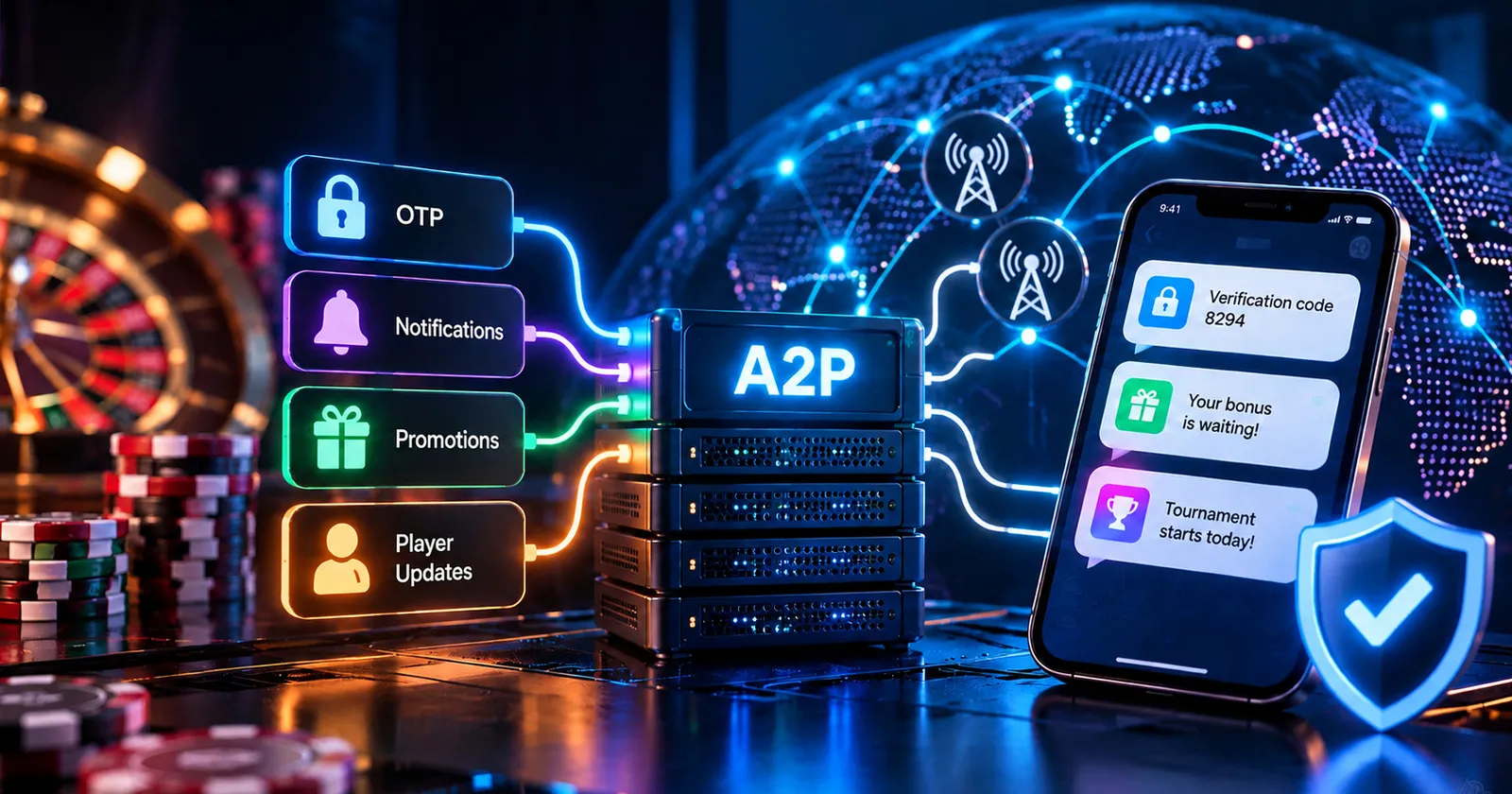
Modern mobile marketing requires reliable delivery of transactional, operational, and promotional messages. A2P messaging for iGaming enables platforms to automatically send OTP codes, transaction notifications, and other messages to users directly from their software systems.
If you are choosing the best channel for sending messages, check out our article on choosing the right channel for iGaming messaging, which compares SMS, WhatsApp, and Telegram in detail. In this article, we will examine why standard aggregators block such projects and how specialized messaging delivery infrastructure works.
What is A2P and How It Differs from P2P
In telecom, messages are typically divided by sender and recipient type. P2P (person-to-person) refers to messaging between individual users. A2P (application-to-person) refers to messages sent automatically from an application, website, or software system to a user.
A2P includes verification codes (OTPs), service notifications, transaction alerts, and marketing communications. Mobile operators often establish separate requirements for routing, sender ID, message content, and pricing for this type of traffic.
For iGaming, this infrastructure is particularly crucial due to varying regulations and delivery rules across different countries.
Why iGaming is Classified as a High-Risk Vertical
iGaming is a heavily regulated vertical, which is why universal SMS aggregators may restrict such traffic or decline it in certain markets. Requirements depend on the country, mobile network operator, message content, project license, and sender ID used.
When a provider serves clients from various industries simultaneously, they must account for requirements across all traffic types and available routes. As a result, an iGaming project may face extra moderation for sender IDs and message templates, restrictions on specific destinations, or outright refusal in certain markets.
For this reason, before launching bulk SMS campaigns for gambling, it is vital to clarify in advance whether the provider supports the vertical and which routes are available for your target countries.
What Happens When Sending via a Standard Provider
Attempting to launch bulk SMS campaigns for gambling through a general aggregator without pre-approving routes inevitably leads to campaign failure. In practice, this usually looks like this:
- Sender ID Verification: The operator’s compliance team rejects the sender ID during the moderation stage.
- Account Suspension: After the first user complaints about promotional messages, operators' automated filters block the sender's entire account.
- Loss of Budget: Funds deposited into the general aggregator's balance are frozen without refund options, and the campaign is ruined.
How A2P Infrastructure Works
Specialized A2P infrastructure enables platform-level messaging integration and allows routing management based on market, channel, and message type.
Key elements of such a system include:
- Routing: Different delivery routes may be used for different countries and mobile operators. If the primary destination is unavailable, the system switches to a backup route — this is known as cascade routing.
- HTTP API: An API allows you to integrate SMS sending with your website, app, CRM system, or internal platform, triggering automated messages based on specific events.
- SMPP Integration: The SMPP protocol is used for server-to-server SMS traffic exchange and is ideal for high-volume projects.
- Fallback Channels: If a message fails to deliver via the primary channel, a fallback scenario can reroute it through another available channel.
Neutral vs. Branded Sender IDs
When working with mobile operators, how the sender ID appears to the end user is critical. During project launch or in strictly regulated regions, pre-validated neutral numeric or alphanumeric sender IDs are often used.
iGamingSMS supports neutral sender IDs without pre-registration as well as branded sender IDs for licensed operators. The availability of specific options depends on the target market and local sender requirements.
Regulatory Specifics Across Regions
Mobile communications legislation varies significantly by region. For example, in several Latin American countries (such as Mexico, Peru, or Colombia), regulations governing automated messaging have unique specifics: some require strict content registration with local regulators, while others are more flexible with international traffic provided basic security standards are met.
Successful Routing Example: A major international project in Turkey processed a total of 10.4 million messages per month using a multi-channel approach (messaging apps with fallback to SMS). This achieved a net click-through rate (CTR) of 7.4% while keeping infrastructure costs to a minimum.
Pre-Connection Checklist
Before signing a contract with a messaging provider, ensure the following features are supported:
- Dedicated routes tailored specifically to your vertical.
- Support for automated channel fallback (cascade routing).
- Transparent analytics protected against artificial inflation and bot traffic.
- 24/7 technical support with defined SLA response times.
Conclusion
A2P infrastructure allows iGaming projects to automate transactional, operational, and marketing messages while managing delivery across various countries and channels.
When choosing a provider, look beyond SMS pricing: consider route availability for target markets, HTTP API and SMPP support, cascade routing capabilities, sender ID options, and analytics quality. It is equally essential to verify in advance whether the provider accepts iGaming traffic and what country-specific restrictions apply.
There is no one-size-fits-all route for every market and scenario. For OTPs, delivery speed is paramount; for retention and CRM messaging, automation and segmentation take priority; and for bulk campaigns, combining multiple routes with fallback channels is key.
Ultimately, A2P messaging for iGaming should be viewed not as standalone SMS delivery, but as an integral part of the platform's broader communication infrastructure connecting messages, routing, and user base management.
Frequently Asked Questions
How does application-generated messaging differ from standard text messaging?
Personal messaging (P2P) occurs between individuals, whereas automated messaging (A2P) is sent from software to a user — including OTP codes, system alerts, or promotional offers. Mobile operators govern and price these traffic flows under entirely different rules.
Why do general-purpose SMS providers reject iGaming projects?
iGaming is considered a high-risk category by most standard aggregators. This is due to higher spam complaint rates, strict legal restrictions across different jurisdictions, and the significant risk of a shared route getting blocked for all provider clients, not just the single sender.
What happens if you send iGaming messages through a standard provider without notice?
Best-case scenario: the operator blocks the specific sender ID after initial subscriber complaints. Worst-case scenario: the provider freezes the entire account along with all deposited funds without refund.
How quickly can specialized routes be set up?
HTTP API integration usually takes a few days on the client side, while establishing a direct SMPP connection may require more time depending on your platform's architecture. Before full launch, you can always request test messaging on a limited pool of numbers.