
Welcome Flow for iGaming: Why Registrations Go Cold in the First Hour
9 min read
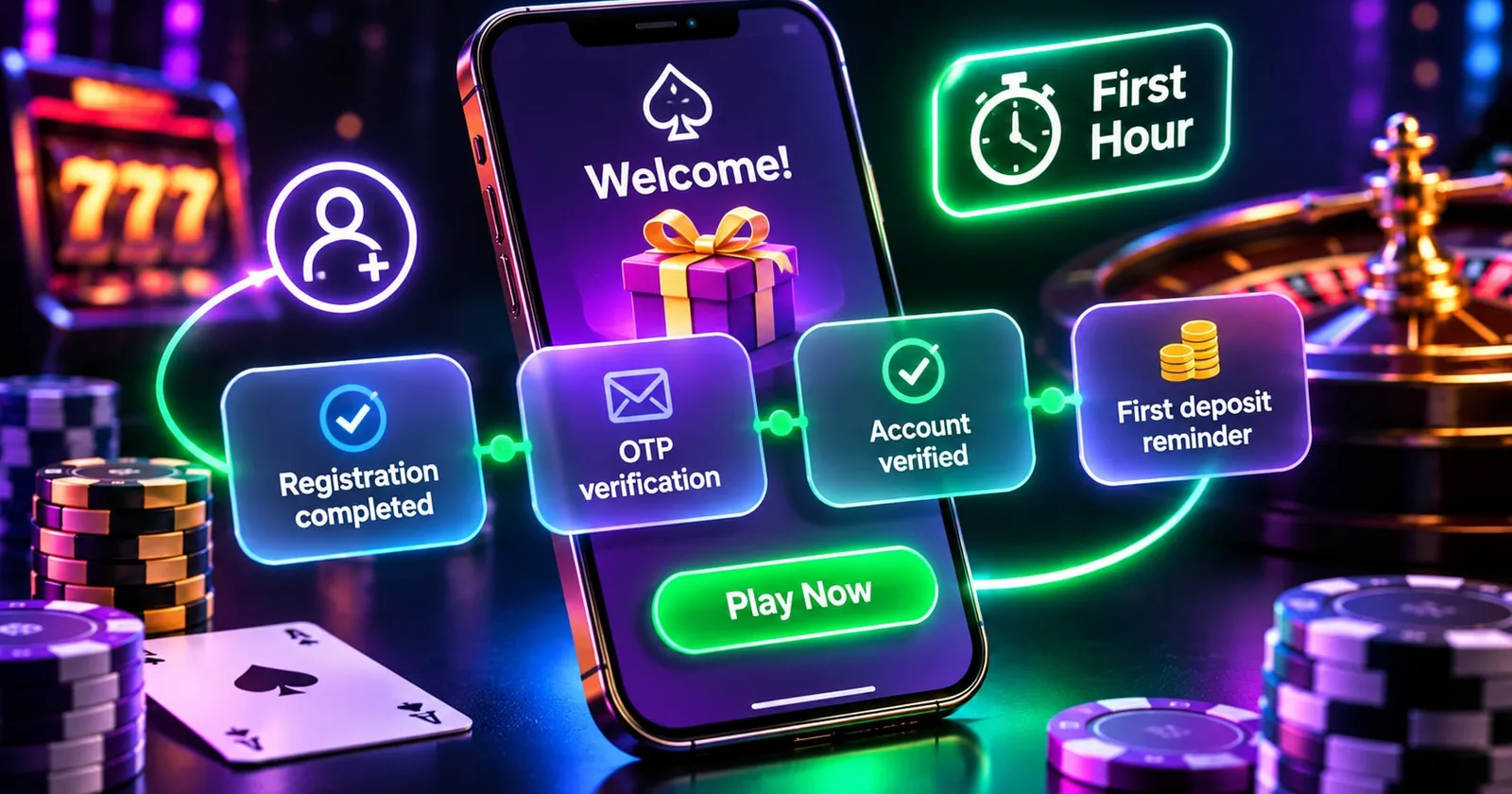
A registration does not automatically lead to the next step. A well-designed welcome flow for iGaming connects sign-up with verification and the next target action while the registration is still recent and the context is clear.
If nothing happens after sign-up — no confirmation, OTP or clear next step — the onboarding sequence is interrupted. A message sent much later may reach the same person, but without the immediate context of the registration.
This is why first-hour messaging works better as a short sequence of triggered messages connected to specific events rather than as a regular scheduled campaign.
What Is a Welcome Flow?
A welcome flow is a sequence of triggered messages connected to specific actions or statuses in player onboarding.
A scheduled campaign starts because the operator has selected a date and audience. An onboarding flow starts because something has happened on the platform: a player has completed registration, needs OTP verification or has not completed the next expected action.
The timing therefore comes from an event rather than the marketing calendar. Instead of sending the same communication to every recent registration, the operator can define different triggers for different statuses.
For more examples of welcome messages and OTP scenarios, see 10 Automated Notification Scenarios for Gaming Platforms
For a broader look at the acquisition stage, see Retention vs Reactivation vs Acquisition: Different Mechanics, Different Channels
What Happens During the First Hour?
The exact sequence depends on the platform and its onboarding process, but a basic first-hour flow can look like this:
Registration → welcome message → OTP verification → next-step guidance
These are not unrelated campaigns. Each trigger depends on the current status of the player.
After sign-up, the platform can trigger a welcome message confirming that the account has been created and showing the next step. If verification is required, an OTP can be sent as transactional traffic.
Once verification is complete, the platform checks whether the next target action has occurred. If it has not, a first deposit reminder can be triggered according to rules defined by the operator.
Before each message is sent, the system should check whether that message is still relevant.
Starting Point: First-Hour Timing
A possible starting sequence is two or three relevant touchpoints during the first hour: a welcome message after registration, an OTP when verification is requested, and next-step guidance after verification. These are event-based messages, not three mandatory broadcasts.
If the first deposit remains incomplete, the operator can test a separate reminder after 24–48 hours. The interval should be adjusted using actual player behaviour, campaign results and local communication requirements.
Welcome-Flow Stages and Channels
A basic onboarding flow can be mapped before the technical integration starts.
| Stage | Channel | Trigger | Objective | Example |
|---|---|---|---|---|
| Sign-up completed | SMS | Registration event | Confirm registration and show the next step | “Welcome to {Brand}. Your account is ready. Continue here: {link}” |
| Verification required | SMS | Verification request | Deliver an OTP | “Your verification code is {OTP}. It expires in {X} minutes.” |
| Verification completed | SMS / messenger | Verified status | Direct the player to the next action | “Your account is verified. Continue here: {link}” |
| Next action incomplete | SMS | Status unchanged after a defined interval | Remind the player about the unfinished step | “You haven’t completed your next step yet. You can return to your account here: {link}” |
| Valid deadline approaching | SMS | Scheduled trigger + eligibility check | Communicate the deadline | “The current offer expires tonight at 23:59. Details: {link}” |
These are illustrative message examples. The operator is responsible for message content, sender ID, eligibility rules and required recipient consent. Promotional messages, including first deposit reminders, should also provide an opt-out mechanism where required by applicable regulations.
Why SMS Is Often Used for Registration Flows
SMS has a practical advantage at the beginning of player onboarding: receiving it does not require a particular messenger application to be installed.
This makes SMS useful for registration confirmations, OTP verification and other short, time-sensitive notifications.
It is also important to separate message types. OTP and other transactional traffic have different delivery requirements from promotional communication.
WhatsApp and Telegram can be considered for other stages where richer formats and the operator’s communication setup make them appropriate.
For a detailed comparison of SMS for registration flows and other channels, see SMS, WhatsApp, or Telegram: What to Choose for iGaming Messaging in 2026
For more on A2P messaging infrastructure, see What Is A2P Messaging and Why Standard SMS Providers Reject iGaming Projects
How to Schedule First Deposit Reminders
A first deposit reminder should be connected to the current account status rather than sent automatically to every recent registration.
A simple trigger logic can look like this:
Registration completed → verification completed → target action not completed → wait for a defined interval → check status → trigger message
The status check prevents an unnecessary reminder from being sent after the player has already completed the action.
A practical starting point is to test a first deposit reminder 24–48 hours after registration if the target action remains incomplete. This interval is a test scenario rather than a universal benchmark. Operators should adjust the timing based on conversion data, player behaviour and applicable communication rules.
If the campaign has a real deadline, the message can communicate it directly:
“Your offer expires tonight at 23:59. Details: {link}”
The deadline should correspond to the actual campaign conditions rather than being added only to create urgency.
How to Trigger Messages via HTTP API or SMPP
Welcome-flow automation can be connected to events generated by the operator’s platform.
A simplified process looks like this:
Platform event → trigger → message request → delivery status → analytics
iGamingSMS supports HTTP API and SMPP for integrating messaging with an operator’s systems.
A platform event — such as registration or a change in verification status — can initiate a message automatically instead of waiting for a manually scheduled campaign. Depending on the integration, delivery and interaction data can then be returned to the operator and used in CRM and retention workflows.
In the Brazil welcome-flow case, messages are triggered from the client’s platform via API, with unique text per number.
Why Raw CTR Can Be Misleading
A request to a tracking URL does not necessarily mean that a person clicked the message.
Carrier link checks, preview bots, crawlers and other automated systems can access links before a recipient does. iGamingSMS uses bot and machine-traffic filtering in its analytics.
A simplified measurement chain is:
Delivered messages → tracked clicks → identified machine traffic excluded → Clean CTR
For CRM and retention teams, Clean CTR can provide a more useful basis for comparing templates, triggers and onboarding stages than an unfiltered click count.
It should still be analysed together with delivery and downstream conversion data rather than treated as the only performance metric.
Case: Welcome Flow in Brazil
An anonymised Brazil case provides an example of this setup.
| Parameter | Result |
|---|---|
| Market | Brazil |
| Use case | Welcome flow and first deposit triggers |
| Channel | SMS |
| Volume | 180,000 messages per month |
| Clean CTR | 9.2% |
| Integration | Triggered from the client’s platform via API |
| Message logic | Unique text per number |
The 9.2% Clean CTR should not be treated as a universal benchmark. Results can vary depending on the market, player base, traffic source, timing, message content and campaign setup.
The case demonstrates the underlying architecture: a platform event initiates a triggered SMS, message content can be unique for each number, and engagement is evaluated after machine traffic is filtered.
Three Common Welcome-Flow Mistakes
1. Sending the Same Message to Everyone
A new registration, an account awaiting verification and a verified account that has not completed the next step represent different stages of player onboarding.
Triggered messages should reflect those differences. Otherwise, the operator risks sending a message that no longer matches the player’s actual status.
2. Sending a Welcome Message Too Late
A welcome message is easiest to understand while the registration context is still recent.
For this reason, the trigger should be connected directly to the registration event rather than waiting for the next scheduled campaign. The objective is not to promise a particular delivery time, but to initiate the message when the relevant event occurs.
3. Mixing Transactional and Promotional Traffic
An OTP and a promotional reminder have different purposes.
OTP verification is a transactional event. Promotional communication belongs to a different messaging flow and may have different routing and campaign requirements.
Keeping the two types separate also makes delivery and performance analysis clearer.
Responsibility for Content and Consent
iGamingSMS provides messaging infrastructure and delivery services, including SMS, WhatsApp, Telegram, HTTP API and SMPP. Message content, sender ID and the collection of required recipient consents remain the client’s responsibility.
Build the Flow Around Events
A useful welcome flow does not need to be long.
Start with the events that matter: registration, OTP verification and the next target action. Define what triggers each message, when that trigger should be cancelled and which metrics will be used to evaluate the step.
Then optimise the sequence using actual delivery, Clean CTR and conversion data.
This turns first-hour messaging into part of player onboarding rather than another scheduled broadcast. The message appears because a relevant event has occurred — or because a predefined next step has not.
FAQ
Why do registrations that go cold in the first hour rarely come back?
The first hour preserves the immediate context of registration. If the onboarding sequence stops after sign-up, a later message may arrive after that context has weakened. A short sequence of welcome and verification messages keeps communication connected to a clear next action.
Which channel is best for a welcome flow?
There is no universal channel for every stage. SMS is useful for short registration and verification messages because receiving it does not require a particular messenger application to be installed. WhatsApp or Telegram may be used at other stages depending on the market, available contact data and communication setup.
How many messages should a welcome flow include?
There is no universal number. A practical starting point is a welcome message, OTP where verification is required, and one or two first deposit reminders. Additional triggered messages should be added only when delivery, click and conversion data provide a reason to extend the sequence.
How do I know the clicks in my report are real people?
Automated systems can access tracking links before a recipient does. Clean CTR filters identified machine traffic from the calculation, providing a clearer view of human interaction with the link.
Can a welcome flow be automated through an API?
Yes. iGamingSMS supports HTTP API and SMPP integration for automated messaging. In the Brazil case, SMS messages are triggered from the client’s platform via API.
Can sender restrictions affect SMS delivery?
Yes. Delivery depends on destination-market requirements, sender ID rules, routing conditions and message classification. Operators should check applicable requirements before launching a registration or promotional flow. No provider can guarantee delivery to every recipient.
How is SMS pricing calculated?
SMS pricing depends on the destination market, message volume, routing requirements and other campaign parameters. Operators can request a quote based on their expected traffic and target countries.